
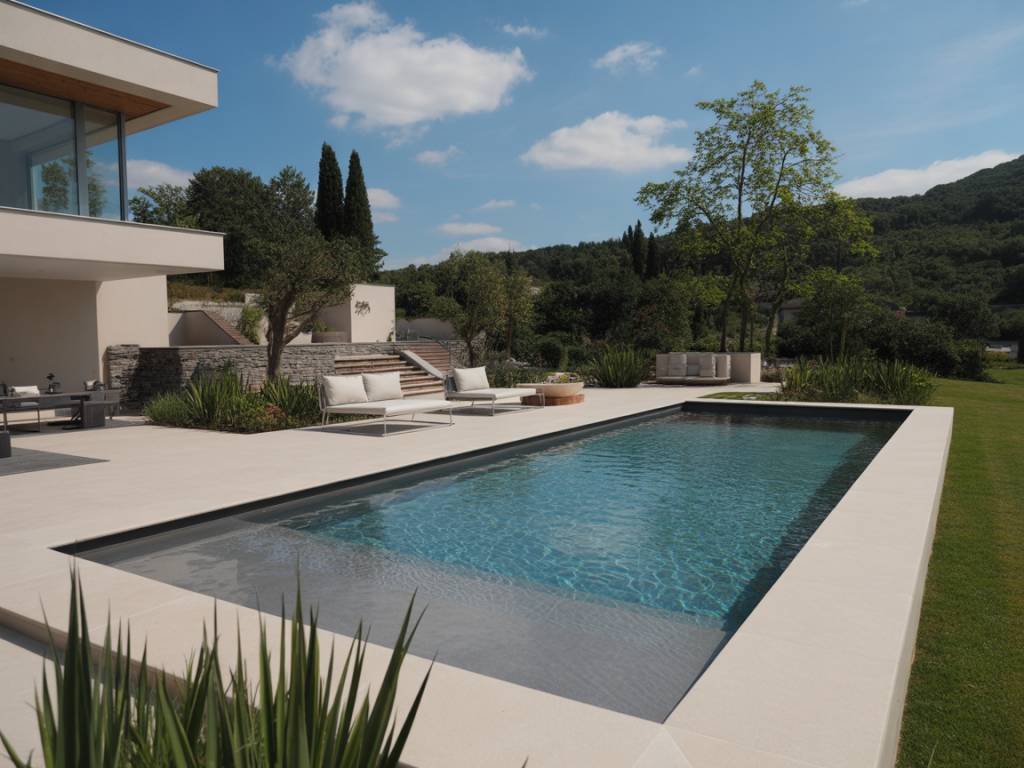
There is a moment — usually around midday in midsummer — when a stainless steel pool stops looking like a construction material and starts looking like a piece of sky captured in your garden. The water shimmers, the brushed metal catches the light, and something clicks. If you’ve been wondering what you need to know about inox pools in modern landscaping, you’re not alone. Homeowners, garden designers, and architects across the UK are increasingly drawn to this sleek, durable option — and for very good reasons.
What you need to know about inox pools in modern landscaping: the basics
The term « inox » comes from the French word for stainless steel — a corrosion-resistant alloy primarily composed of iron, chromium, and nickel. An inox pool is a swimming pool built almost entirely from this material: walls, floor, steps, overflow edges, and built-in fittings are all fabricated from the same seamless metal shell.
Unlike traditional concrete or fibreglass pools, inox pools are prefabricated off-site, engineered to precise specifications, and then craned or lowered into a prepared excavation. This is not a DIY project — it requires architectural drawings, planning permission in many cases, and a specialist installation team. But the result is a pool that can last 50 years or more with minimal structural intervention.
Key technical specs worth knowing:
- Most inox pools use grade 316L stainless steel, chosen for its superior resistance to chlorine, salt water, and frost.
- Wall thickness typically ranges from 3 to 6 mm, depending on pool size and ground conditions.
- Surface finish options include brushed, mirror-polished, or sandblasted — each producing a distinct visual and tactile effect.
- Pool sizes are fully customisable: from compact 3 x 2 m plunge pools to full 25 m lap pools.
Why inox pools are reshaping modern garden design
For decades, garden pools meant either a blue-tiled concrete tank or a moulded fibreglass shell. Inox pools represent a genuine design shift — one that mirrors broader trends in architecture and outdoor living. Here is why they are increasingly specified in contemporary landscaping projects:
Longevity that outperforms traditional materials
Concrete pools can crack with ground movement and require resurfacing every 10–15 years. Fibreglass can fade, blister, or delaminate. Stainless steel, by contrast, is non-porous, frost-resistant, and chemically stable. It does not harbour algae in the same way as grouted tile surfaces, and it maintains its structural integrity through extreme temperature variations — a significant advantage in the unpredictable British climate.
A design language that speaks to the modern garden
Inox pools don’t try to mimic nature. Instead, they engage in a dialogue with it. The reflective surface responds dynamically to the surrounding environment: trees, clouds, and open sky all appear in the water as living, moving images. This quality makes them particularly powerful in minimalist, contemporary, and Japanese-influenced garden styles, where negative space and clean geometry are paramount.
Their industrial elegance also pairs unexpectedly well with organic materials. Weathered timber decking, rough-cut limestone, corten steel planters, and ornamental grasses all create a sense of warm contrast that prevents the pool from feeling clinical or cold.
Precision customisation at every level
Because stainless steel is formed from flat sheets welded to specification, inox pools can achieve shapes and details that are difficult or impossible in other materials:
- Infinity and overflow edges that create a seamless water horizon
- Raised or semi-raised formats suitable for rooftop terraces and sloped plots
- Integrated benches, sun ledges, and steps fabricated from the same steel shell
- Narrow lap pool formats as slim as 2 m wide — ideal for town garden plots
- Indoor–outdoor installations passing through a glazed wall for year-round use
Landscaping around an inox pool: design principles that work
The single most common concern homeowners raise is that a stainless steel pool will look out of place in a natural garden. With thoughtful planting and material choices, the opposite tends to be true. The key is deliberate contrast rather than imitation.
Planting combinations that complement steel
Soft, textural planting is the most effective counterpoint to hard, reflective metal. Consider these approaches:
- Lavender and rosemary along pool edges — aromatic, drought-tolerant, and visually soft against brushed steel.
- Ornamental grasses such as Miscanthus or Stipa tenuissima, whose movement is amplified by the reflective surface nearby.
- Creeping sedum or thyme spilling over raised coping stones for a naturalistic, low-maintenance fringe.
- Wildflower meadow borders for a dramatic contrast — the chaos of colour reflected in still steel is genuinely arresting.
Hard landscaping materials that work in harmony
The pool surround is critical to the overall feel of the space. Materials that tend to work well alongside inox pools include:
- Pale limestone or sandstone paving — warm, neutral tones that balance the cool metal.
- Hardwood or composite decking — adds texture and warmth, particularly effective in a contemporary courtyard setting.
- Corten steel planters or screens — the rusted orange echoes the industrial quality of the pool while adding colour depth.
- Gravel or crushed slate ground cover — low maintenance and visually cohesive in a minimalist scheme.
Maintenance: the genuine advantage of a stainless steel pool
Many pool owners underestimate the long-term cost of maintaining a conventional pool. Inox pools offer a compelling maintenance story:
- Non-porous surface means algae and bacteria have nowhere to anchor, reducing chemical treatment requirements significantly.
- No grout lines or tiles to crack, stain, or require replacement.
- Calcification at the waterline is far easier to remove from smooth steel than from textured tile surfaces.
- Standard brushing and vacuuming routines are sufficient for most upkeep — no specialist coatings or resurfacing required.
Paired with a modern variable-speed pump and UV filtration system, an inox pool can be genuinely efficient to run — both in terms of time and energy consumption.
Cost and investment: what to expect
Inox pools carry a higher upfront cost than fibreglass or vinyl-liner pools. In the UK market, installed prices typically begin around £30,000–£40,000 for a compact plunge pool and rise substantially for larger or more complex designs. However, when lifecycle costs are factored in — reduced resurfacing, lower chemical consumption, and exceptional structural longevity — the total cost of ownership over 25 years can compare favourably with cheaper alternatives that require more frequent intervention.
An inox pool is best understood as a long-term capital investment in your property, not simply a leisure feature. In high-value properties with contemporary architecture, it can meaningfully enhance market appeal.
Three landscaping scenarios where inox pools shine
- The urban courtyard: A compact inox plunge pool surrounded by pale limestone pavers, vertical planted walls, and overhead string lighting. Minimal footprint, maximum impact.
- The wildflower garden: A long stainless steel lap pool running parallel to a meadow border, its surface catching the movement and colour of native flowers in bloom through the summer months.
- The evening terrace: A raised inox pool with overflow edge, integrated LED lighting beneath the water line, and a hardwood deck furnished with low-slung chairs. By dusk, the steel dissolves into the sky — and the garden becomes something else entirely.
Whether you are redesigning an existing outdoor space or planning from scratch, an inox pool offers a rare combination of technical performance and genuine aesthetic ambition. For gardens that lean into modernity, precision, and longevity, it is one of the most compelling investments available — and increasingly, one of the most distinctive.